Openers · Hamilton
Chain-Drive Opener Repair
The motor runs, you can hear it working, but the door never moves. When you look up, the sprocket on top of the head is barely turning, and there is a little drift of pale plastic dust on the cover.
Chain-Drive Opener Repair
In plain words
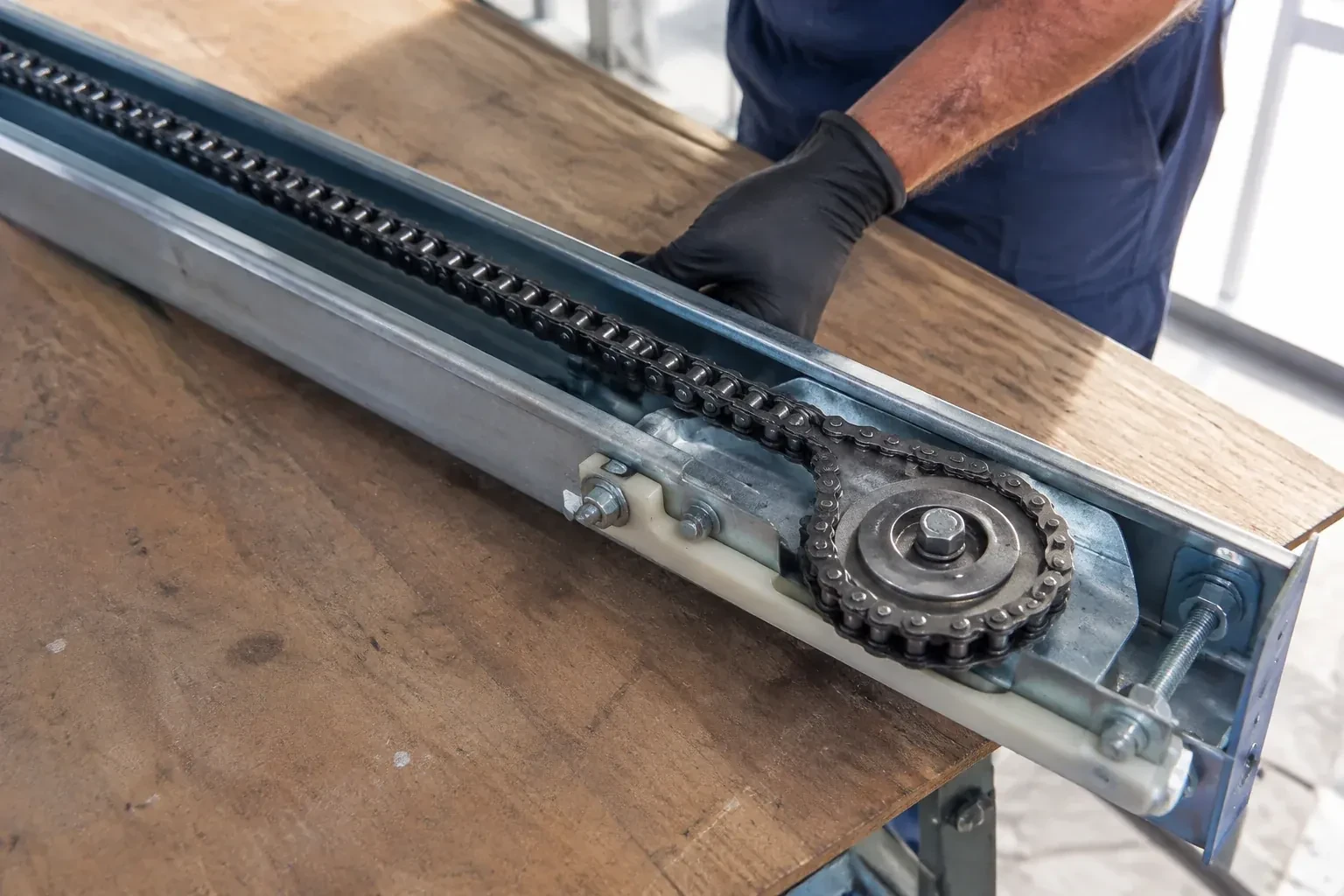
Chain tension is set by measurement, not by feel. With the door closed and disconnected from the trolley, a correctly tensioned chain sits at the height the opener's own manual specifies for its rail shape, measured at the middle of the rail, since the figure differs between makes and rail types. Two nuts on the trolley do the work: the outer one raises or lowers the chain and the inner one locks the setting. A chain that hangs lower slaps and skips; one pulled tighter than that wears the sprocket and loads the motor bearings. The technician checks the manual, sets the chain, locks it and runs the safety tests.
How the visit goesThe rail shakes when the door runs. The steel straps holding it to the ceiling have worked loose, the chain rattles the length of the garage, and a bolt has already dropped onto the hood of the car.
Hamilton
How the visit goes
Under the head cover
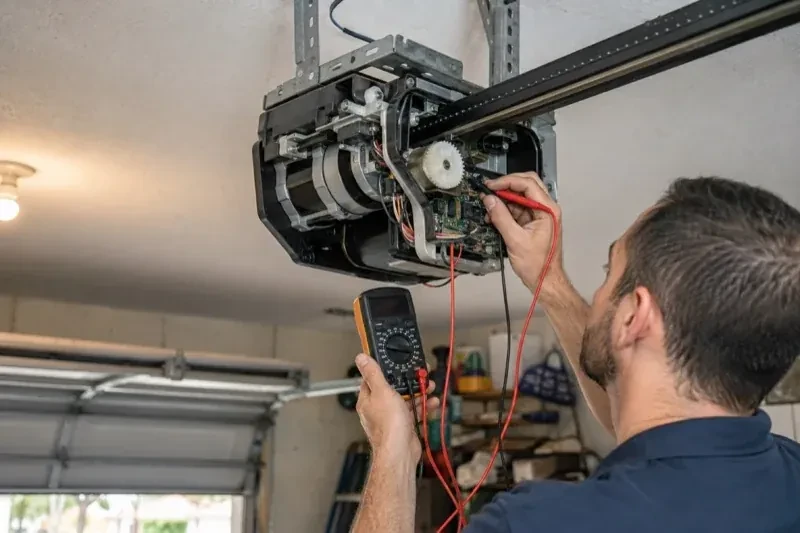
With the power off, the cover comes off the motor head so the drive can be seen. The technician looks for pale shavings around the drive gear, which mean the teeth are wearing away, and for a sprocket shaft that rocks when pushed, which points to worn bushings. The worm gear on the motor shaft is checked for scoring, the grease is judged for age and cold-thickening, and the capacitor is inspected for swelling. On newer heads the RPM sensor and its magnet are checked, since a faulty one makes the operator lose track of how far the door has moved. This look decides whether the job is a gear kit, a chain or an adjustment.
Freeing the trolley and renewing the carriage
A trolley lodged against the stop bolt is released rather than forced. The door is disconnected at the red handle, the outer tensioner nut is backed off several turns to slacken the chain, and the operator is run so the trolley travels away from the stop under its own drive. The limit is then pulled back so the trolley stops short of the bolt in future. Where the inner or outer trolley shows wear, a cracked latch or a bent release lever, the worn piece is replaced with the model's part and the release is checked to pick the door arm up on the first pass. The chain is re-tensioned to specification afterwards.
A record of the drive as it is now
Before leaving, the technician writes down what was found and what was fitted: the operator's model and age, whether the gear kit, sprocket, chain, trolley or rail hardware was replaced, the tension figure set, the limit and force positions, and the results of the reversal tests. The manual is hung near the wall control so the model's own instructions are at hand for the monthly tests. This note makes any future call a short conversation, tells a home inspector what has been done, and gives whoever owns the house next a clear picture of what is hanging over the car.
Chain-Drive Opener Repair
In the van
- Cold-rated garage door lubricant
- Idler sprocket or pulley
- Sprocket and shaft assembly
- RPM sensor
- Motor start capacitor
What affects the quote
Same fees day, night or weekend
1Rail hardware and hangers
Loose hangers, a header bracket that has pulled from the framing, or splice plates that need renewing add fasteners, angle iron and time on the ladder to a job that might otherwise be an adjustment.
2Age of the operator and parts supply
Parts for recent heads are on the van; parts for a unit several decades old may need ordering, and where a maker no longer supplies them the conversation turns to what can be done instead.
3A detached or unheated garage
Cold-rated lubricant, a chain replaced rather than freed, and force set for low temperatures are choices made for a garage that sees winter, and they show in the parts and the time.
Chain-Drive Opener Repair: questions
Can you turn the force up so the door closes on cold mornings?
Force is set to the lightest level that moves the door reliably, and it is raised only a little for a cold garage. Turning it up further to overcome a heavy door or a seal frozen to the slab is not done, because too much force interferes with the safety reversal and can bend the top section. If the door is hard to move in the cold, the springs, rollers or the frozen seal are dealt with instead.
Will the safety reversal be tested as part of the repair?
Always, and after every adjustment, because changing tension, limits or force changes how the operator senses an obstruction. The door is closed onto a 38 mm block on the floor and must return to open on contact, then closed again while the low sensor beam is interrupted and must reverse the same way. If either test fails the settings are revisited until both pass, and you are shown the tests so you can repeat them monthly.
Why does the door touch the floor and then go back up?
The operator believes it has hit something. Either the down travel limit is set a little too far, so the door is pressing into the floor past its stopping point, or the closing force is set too low for the door's current weight, so the last push reads as an obstruction. A seal frozen to the slab causes the same reversal in winter. The technician adjusts the limit or the force, in that order, and re-tests the reversal afterwards.
Openers & Access
- Belt-Drive Opener RepairHalfway up, every single time, the door hesitates and there is a ratcheting sound from the motor…
- Garage Door Opener ReplacementPress the button and the motor hums, but the door stays exactly where it is.
- Photo-Eye Sensor Alignment or ReplacementYou press the remote, the door drops a few centimetres, then climbs straight back to the top while…
Chain-Drive Opener Repair near you
In Hamilton we work on garage doors of every age and size: single and double residential doors, insulated and uninsulated, wood and steel, plus commercial rolling and sectional doors. The service pages explain the repairs, replacements and installations that apply to each.