Openers · Lynden
Chain-Drive Opener Repair in Lynden
The motor runs, you can hear it working, but the door never moves. When you look up, the sprocket on top of the head is barely turning, and there is a little drift of pale plastic dust on the cover.
Chain-Drive Opener Repair
In plain words
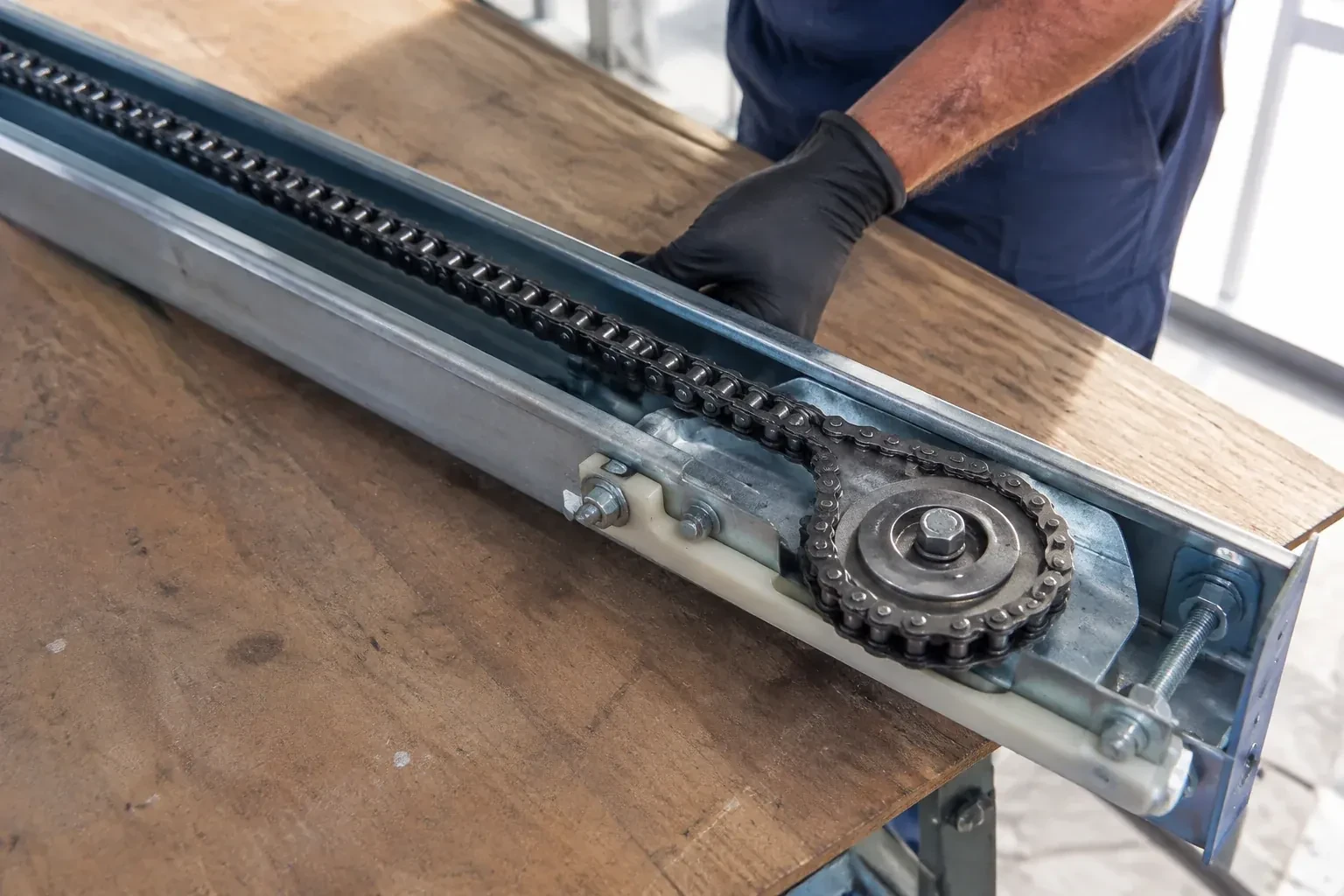
Chain tension is set by measurement, not by feel. With the door closed and disconnected from the trolley, a correctly tensioned chain sits at the height the opener's own manual specifies for its rail shape, measured at the middle of the rail, since the figure differs between makes and rail types. Two nuts on the trolley do the work: the outer one raises or lowers the chain and the inner one locks the setting. A chain that hangs lower slaps and skips; one pulled tighter than that wears the sprocket and loads the motor bearings. The technician checks the manual, sets the chain, locks it and runs the safety tests.
How the visit goesThe chain hangs in a loop under the rail and slaps against it on every cycle. It used to sit snug. Now the whole house hears the door leave, and the sound has a metallic clatter it never had before.
Lynden
How the visit goes
Where the door stops and how hard it pushes
Two settings on the head decide the door's behaviour, and both are checked against what the door is doing. Travel limits set where the door stops in each direction; a door that stops shy of the floor, reverses on touching it or opens partway is out of adjustment. Force sets how much effort the operator treats as normal; too little and the door reverses for no reason, too much and the operator stops noticing an obstruction. The technician notes the current screw positions or the learned values, watches a full cycle and compares what the door does with what the settings say, before deciding whether the fault is in the drive parts or only in the settings.
Resetting travel and force
With the drive mechanically sound, the operator is taught the door again. On older heads, the up and down limit screws are turned with a flat screwdriver, each full turn moving the stop about 5 cm, until the door meets the floor with the seal lightly compressed and opens to full height without the trolley reaching the bolt. Force is set to the lightest level that moves the door reliably through a full cycle in the garage's normal temperature. Newer heads run a learn cycle from buttons on the back and measure both for themselves. The operator is then cycled several times to confirm the settings hold.
How the chain ages from here
A new or freshly tensioned chain settles over its first weeks of use, so a small change in sag is expected and was allowed for. Over years, though, a chain lengthens a little at a time. Glance at it now and then with the door open: if it has dropped visibly below where it sat after the repair, or has started to tap the rail, it is due for tensioning. Do the same after any winter when the garage has been especially cold. Surface rust on a chain in an unheated garage is worth mentioning at the next service before it stiffens the links.
Chain-Drive Opener Repair
In the van
- Cold-rated garage door lubricant
- Idler sprocket or pulley
- Sprocket and shaft assembly
- RPM sensor
- Motor start capacitor
What affects the quote
Same fees day, night or weekend
1Rail hardware and hangers
Loose hangers, a header bracket that has pulled from the framing, or splice plates that need renewing add fasteners, angle iron and time on the ladder to a job that might otherwise be an adjustment.
2A detached or unheated garage
Cold-rated lubricant, a chain replaced rather than freed, and force set for low temperatures are choices made for a garage that sees winter, and they show in the parts and the time.
3Trolley and release parts
A worn inner or outer trolley, a cracked latch or a bent release lever are replaced as separate pieces, and whether any of them is needed shows only once the trolley has been run along the rail by hand.
Chain-Drive Opener Repair: questions
Can you turn the force up so the door closes on cold mornings?
Force is set to the lightest level that moves the door reliably, and it is raised only a little for a cold garage. Turning it up further to overcome a heavy door or a seal frozen to the slab is not done, because too much force interferes with the safety reversal and can bend the top section. If the door is hard to move in the cold, the springs, rollers or the frozen seal are dealt with instead.
Will the safety reversal be tested as part of the repair?
Always, and after every adjustment, because changing tension, limits or force changes how the operator senses an obstruction. The door is closed onto a 38 mm block on the floor and must return to open on contact, then closed again while the low sensor beam is interrupted and must reverse the same way. If either test fails the settings are revisited until both pass, and you are shown the tests so you can repeat them monthly.
Why does the door touch the floor and then go back up?
The operator believes it has hit something. Either the down travel limit is set a little too far, so the door is pressing into the floor past its stopping point, or the closing force is set too low for the door's current weight, so the last push reads as an obstruction. A seal frozen to the slab causes the same reversal in winter. The technician adjusts the limit or the force, in that order, and re-tests the reversal afterwards.
Openers & Access
- Belt-Drive Opener RepairHalfway up, every single time, the door hesitates and there is a ratcheting sound from the motor…
- Garage Door Opener ReplacementPress the button and the motor hums, but the door stays exactly where it is.
- Photo-Eye Sensor Alignment or ReplacementYou press the remote, the door drops a few centimetres, then climbs straight back to the top while…
Chain-Drive Opener Repair near you
Shops, warehouses and service bays in Lynden have their own list: rolling steel doors, heavy sectional doors, industrial operators, safety edges and high-cycle springs. Alongside our residential work, we service and replace all of these and can set up a maintenance schedule that fits your operating hours.